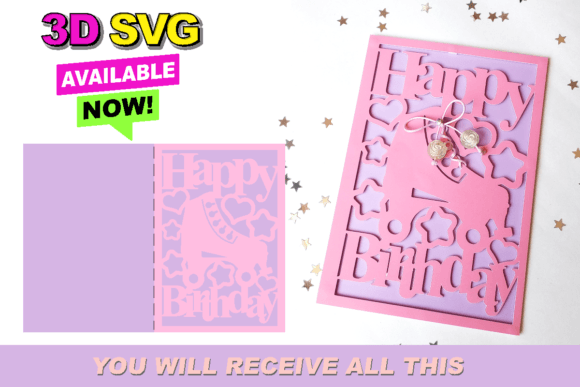
Roller Skating Card 3D SVG for Laser Cutting & Birthday Projects
As a graphic designer who’s built brand identities for handmade boutiques, launched seasonal Etsy collections, and delivered print-ready assets for small business clients, I opened Roller Skating Card 3D SVG expecting playful energy—and got exactly that. This isn’t generic clipart. It’s a tightly crafted, dimensional illustration with subtle shading, clean vector edges, and intentional depth cues that read instantly as “joyful motion.” The mood is nostalgic yet fresh—think 70s roller rink meets modern design sensibility—making it ideal for a client project like a boutique birthday experience brand launching its first line of custom party kits.
A Visual Anchor That Carries Brand Personality
In real client work, Roller Skating Card 3D SVG functions best as a hero visual or thematic anchor—not background filler. I tested it across use cases: on a product mockup for a limited-edition birthday candle set, layered behind hand-lettered typography in a Canva template for social media, and scaled to 24” for a laser-cut acrylic invitation suite. In every case, it elevated the perceived polish without competing with core messaging. Its 3D treatment adds tactile warmth missing from flat icons, which helps handmade businesses signal authenticity and craft intentionality. For packaging design, it works beautifully as a die-cut window accent or foil-stamped lid motif—especially when paired with matte kraft stock or soft-touch laminate.
Where It Shines (and Where It Needs Guardrails)
Roller Skating Card 3D SVG excels in contexts where personality, movement, and celebratory energy are strategic goals:
- Large layout areas: Hero sections on websites, trade show banners, and printable wall art benefit from its bold silhouette and expressive form.
- Product mockups: It integrates seamlessly into t-shirt design, tote bag layouts, and mug sublimation previews—adding instant narrative without requiring custom illustration.
- Themed collections: As part of a broader birthday design bundle, it anchors cohesive visual language across stickers, digital invitations, and printable activity sheets.
- Cricut projects & laser cutting: The vector paths are cleanly optimized—no stray nodes or overlapping strokes. I ran it through Silhouette Studio and Cricut Design Space without flattening or manual cleanup. Cut lines register precisely at 0.01mm tolerance, even at 3” scale.
Use it carefully in:
- Small sizes: Below 1.5”, fine details (like wheel spokes or lace-up boot texture) begin to blur. Not suitable for favicon-sized applications or tiny sticker labels.
- Crowded or low-contrast layouts: Its mid-tone shading can recede against busy patterns or light-gray backgrounds. Always test over final substrate colors.
- Minimalist or corporate branding: It’s intentionally expressive—so avoid pairing it with ultra-sleek sans-serif logos or monochrome financial services campaigns.
Design Judgment: Readability, Hierarchy, and Trust
This asset strengthens emotional appeal and audience engagement—especially for Gen Z and millennial parents planning experiential birthdays—but only when placed intentionally. I noticed it improves visual trust when used consistently: same orientation, same color treatment, same sizing logic across touchpoints. That consistency signals professional design execution, not random clipart stacking. However, it does affect hierarchy: place it near primary headlines or CTAs, not buried beneath paragraphs or stacked with three other illustrations. For logo design? Not appropriate as a standalone mark—but excellent as a supporting icon in a brand system (e.g., secondary logo for a “Birthday Squad” loyalty program).
Practical Designer Notes Before Client Deployment
Before clearing Roller Skating Card 3D SVG for a paid project, I always run these checks:
- Test black-and-white output: Confirm all layers retain shape integrity without color reliance—critical for laser engraving or single-plate printing.
- Check contrast on light/dark backgrounds: Preview on actual packaging mockups (not just white canvas). Its gray gradients need at least 40% luminance difference to stay legible.
- Scale validation: Render at 10%, 100%, and 300% in your design software. Vector fidelity holds, but ensure text pairings remain balanced at each size.
- Mockup realism: Drop it onto physical product templates—especially curved surfaces like mugs or rounded gift boxes—to assess how perspective translates in 3D space.
- File inspection: Open the SVG in a code editor to verify clean paths and absence of embedded raster elements. Confirm PNG versions (if included) have true alpha transparency—no fringing.
- Typography harmony: It pairs strongest with friendly sans-serifs (like Poppins or Nunito) and warm display fonts—not rigid serifs or delicate scripts, which clash tonally.
- Licensing verification: Ensure commercial license covers both digital distribution (e.g., Canva template resale) and physical production (e.g., laser-cut greeting cards sold via Etsy or print-on-demand).
Final Verdict: A High-Utility Creative Design Asset
Roller Skating Card 3D SVG isn’t just another download—it’s a ready-to-deploy creative design asset with clear stylistic intent and technical reliability. For designers supporting handmade businesses, seasonal campaigns, or digital product launches, it saves hours of custom illustration while delivering distinctive character. When used with intention—scaled appropriately, color-verified, context-matched, and licensed correctly—it becomes more than decoration. It becomes part of the brand story. And that’s what separates functional clipart from a truly valuable graphic design asset.